
 Türkçe

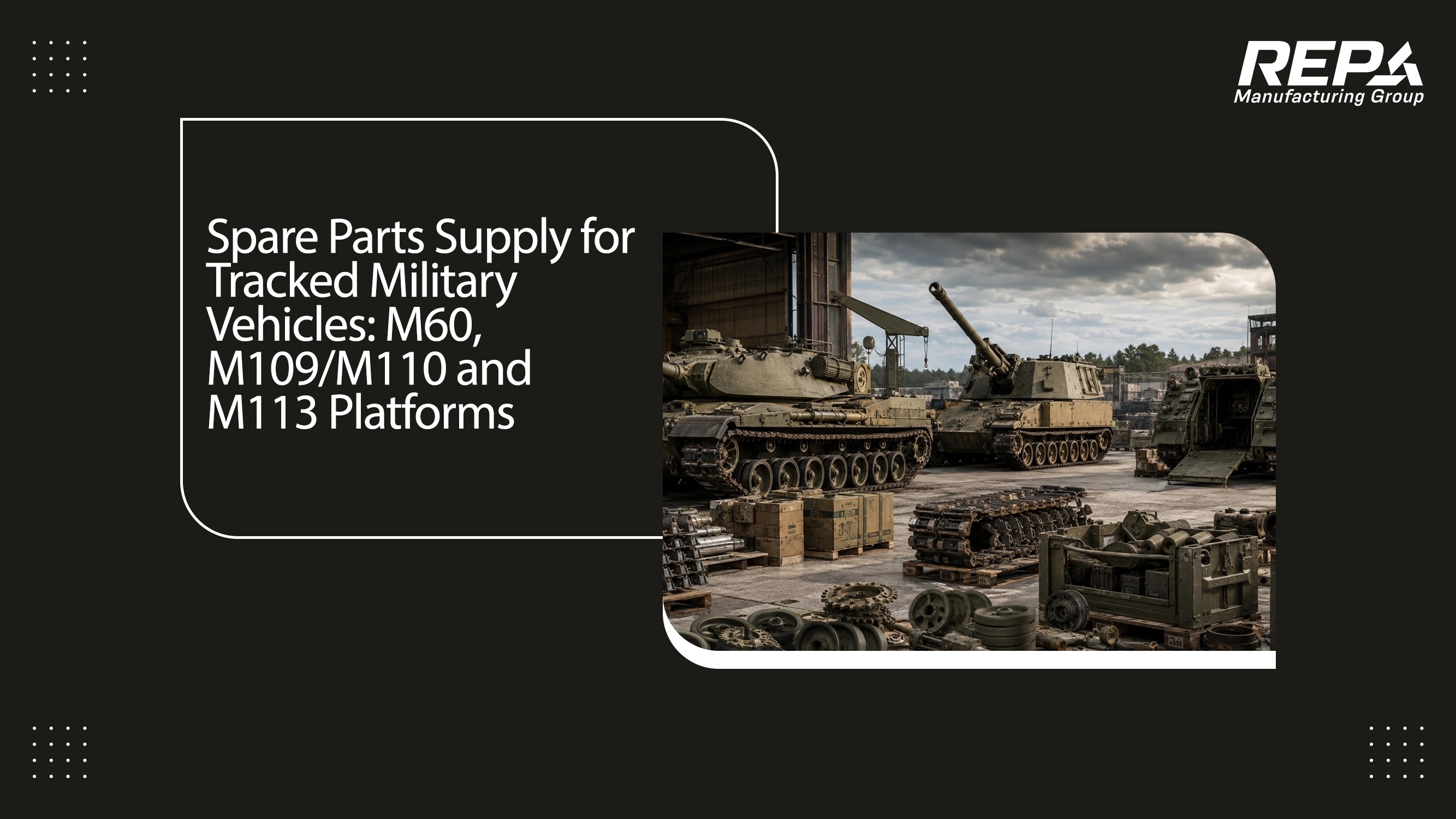
Tracked military vehicles require a different sustainment logic than wheeled platforms. The M60 main battle tank, the M109 and M110 self-propelled howitzers and the M113 armored personnel carrier are high-tonnage platforms that have been in inventory for decades and operate under continuous load. On these vehicles, spare parts supply is not merely a purchasing activity but a technical process that directly determines the operational readiness rate of the fleet.
This article covers the critical part groups on tracked platforms, how to match the correct item through NSN and cross-reference numbers, what to do when a part is out of production, and the quality criteria to examine when evaluating a supplier.
Why Are Spare Parts Different on Tracked Vehicles?
Compared with wheeled tactical vehicles, tracked platforms differ in three respects:
- Load level: Vehicle weight and the friction resistance of the track system generate far higher torque and thermal loads in the powertrain and brake groups.
- Steering principle: On tracked vehicles, turning is achieved by driving the tracks at different speeds. This means brake and clutch elements perform not only a stopping function but also a steering one, and wear rates increase accordingly.
- Platform age: The M60, M113 and M109/M110 families have been in service for a long time, which brings the risk that part of the original supply chain has since closed.
These three factors require part selection on tracked platforms to be handled more rigorously in terms of material, tolerance and traceability.
Critical Part Groups
1. Brake system and friction elements
On heavy tracked vehicles, brake components are exposed to severe thermal loads during repeated braking. If the thermal stability of the friction material is insufficient, fading occurs — a reduction in braking effectiveness as temperature rises — and this is a direct operational safety issue.
Products evaluated in this group include the M60 A3 brake band and lining (NSN 2530-00-679-4495). When selecting, the stability of the friction coefficient, the lining thickness and the conformity of the band geometry to the original technical drawing should be checked.
2. Clutch and power transmission group
Controlled transfer of engine power to the transmission, smooth gear changes and protection of the drivetrain all depend on the condition of the clutch group. Surface wear or thermal deformation on clutch plates can quickly turn into secondary damage on the transmission side.
On the M113 platform, the two main components of this group are the clutch plate assembly (NSN 2520-00-789-4847) and the transfer plate disk assembly (NSN 2520-00-679-7959). These two parts are usually addressed within the same overhaul; checking the condition of one while replacing the other prevents the vehicle from returning to the workshop a second time.
3. Shaft connections
On self-propelled howitzers, power-transmission continuity depends on compensating angular and axial misalignment between shafts. If this compensation is not provided, vibration increases and fatigue cracks form in bearings and connection elements.
The flexible shaft coupling (NSN 3010-00-432-7236) used on the M109 and M110 platforms performs this task. In procurement, the torque capacity and flexibility characteristics of the coupling matter just as much as its connection dimensions.
4. Towing and recovery equipment
The risk of becoming immobilized in the field requires a different recovery approach on tracked vehicles than on wheeled ones. Because dynamic loads on the rope during recovery can rise well above static calculations, the breaking strength of the equipment and the swaging quality of the end fittings are critical.
The 5-meter single-leg wire rope assembly for the M60 / M48 (NSN 4010-00-202-2425) produced for this purpose is used in towing and recovery operations.
Matching the Correct Part by NSN and Cross Reference
On tracked platforms, different variants can exist under the same product name. A brake lining, for example, may come in a different thickness or bolt-hole pattern on different sub-models of the same vehicle family. A product name alone is therefore not enough when raising a request.
Providing the following information together before ordering largely eliminates the risk of receiving the wrong part:
- NSN (NATO Stock Number)
- Part number (P/N) and cross-reference number, if available
- Platform and sub-model data (e.g. M60 A3, M113 A2)
- Technical group (brake, clutch, transmission, recovery)
- A technical drawing or a photograph of the existing part, where possible
To read more about the 13-digit NSN coding structure and how it is used in procurement, see our article What is an NSN?
What to Do When a Part Is Out of Production
On platforms that have been in inventory for a long time, the most common problem is that a part appears in the catalogs but cannot actually be sourced. This happens when the original manufacturer discontinues production, when a sub-supplier in the chain closes, or when the minimum order quantity is far above the actual requirement.
There are two routes at this point: technically verifying an equivalent that is still in production, or re-manufacturing the part. The second route falls under custom manufacturing and reverse engineering and can be started with one or more of the following inputs:
- A physical sample (a used part is sufficient)
- A technical drawing or dimensional sketch
- NSN or OEM part number
- Material, hardness and coating requirements
- Critical dimensions and tolerance ranges
The typical flow is to take measurements from the sample, reconstruct the technical drawing, define the material and heat-treatment conditions, and then subject the first article to dimensional inspection. You can review the CNC machining and measurement infrastructure REPA Manufacturing Group uses in this process on our machinery park page.
What to Examine When Evaluating a Supplier
On tracked platforms, the cost of an incorrect part far exceeds the price of the part itself: the time the vehicle spends in the workshop, the removal and installation labor and the risk of secondary damage determine the total cost. Supplier selection should therefore be questioned under the following headings:
- Quality management system: ISO 9001, AS9100D for defense and aerospace, IATF 16949 for series production discipline
- Traceability: material certificates, production batch tracking and inspection records
- Measurement infrastructure: which instruments are used for dimensional inspection and how often
- References: previous deliveries on comparable platforms
- Delivery performance: track record against committed lead times
You can review REPA Manufacturing Group's quality documents on the certificates page and the institutions it works with on the references page.
Practical Recommendations for Maintenance Planning
- Plan the clutch and transfer disk assemblies within the same overhaul package rather than separately.
- Record brake lining thickness measurements periodically; base the replacement decision on the measurement trend rather than on failure.
- Define a second approved supplier for critical parts to reduce single-source dependency.
- Archive technical drawings and samples in advance for parts at high risk of going out of production; this shortens reverse-engineering time when the need arises.
- Make the NSN field mandatory in your request forms.
Frequently Asked Questions
Which spare parts do you manufacture for the M60, M109/M110 and M113?
We manufacture parts for the brake, power-transmission and recovery groups, primarily the brake band and lining, clutch plate assembly, transfer plate disk assembly, flexible shaft coupling and wire rope assembly. All products can be found on our M60 / M109 / M110 / M113 platform page.
Can a tracked vehicle part that is not in the catalog be supplied?
Yes. Requests submitted with a sample, technical drawing or NSN are evaluated under custom manufacturing, and we respond after a manufacturability analysis.
How should I verify part compatibility?
Using the NSN and the part number together, then confirming the platform sub-model, is the safest method. In case of doubt, a photograph of the existing part and its critical dimensions can be shared.
What is the lead time?
Lead time varies depending on stock availability and whether production is required. When you submit your request with the NSN and quantity, the delivery time is shared together with the quote.
Conclusion
Spare parts supply for tracked military vehicles requires accurate technical identification, quality assurance and preparedness for parts that have gone out of production. Defining items clearly by NSN, establishing a second source for critical groups and evaluating the reverse-engineering option in advance are the most practical ways to protect fleet readiness.
For your military vehicle spare parts requirements on the M60, M109, M110 and M113 platforms, you can contact REPA Manufacturing Group with the NSN or part number to receive a quote.
Related articles: Military vehicle spare parts: a complete guide to selection, quality and procurement · The importance of NSN in HMMWV and Otokar Cobra spare part selection